


Five questions for Andrea Mennillo: "Applying a sound set of values for the next generation of business leaders”
This year the Gabelli School of Business – the undergraduate and graduate business schools of Fordham University in New York, which is proud to cultivate the next generation of business leaders – held its 2018 Awards Ceremony to honor the best students of the inaugural 2014 class.
The ceremony also recognized those people who have made a significant contribution to the ability of the Gabelli School of Business to deliver on the global aspects of its mission.
In particular, the 2018 International Awareness Award was given to Dr. Andrea Mennillo in recognition of his significant contribution to the Gabelli School of Business’s educational mission, particularly its global perspective.
During the celebration at the Lincoln Center to mark the graduation of the first undergraduate class of the Global Business program, Dr. Mennillo was interviewed about the renewed role of education, how it applies to a new generation of business leaders, and how this can prepare them to face a continuously evolving scenario. Below is an excerpt of the interview.
1. Mennillo, in this digital age where innovation and transformation permeate nearly every aspect of society, how are the ways of doing business changing?
Today more than ever it is necessary to be aware that development must do two things: it must be profitable and it must respect a sound set of cardinal values. In this digital age we cannot let discussion about progress ignore human behaviors and limits. This is what I said when I spoke to the Introduction to Business class headed by Donna Rapaccioli, Dean of the Gabelli School of Business. It is fundamental to prepare sophomores to become businesspeople knowing that in just a few years they could face a critical life dilemma: the dilemma between greed or applying ethics-based values. They are in the right season of their lives to think deeply about this issue, and this school provides them with the opportunity to study and build their character before they are confronted with ethical dilemmas in their workplace.
2. In your opinion, which managerial competences are most important in order to deal with this evolving context?
In our digital society, where digitization and automatization are shaping the way we do business, we need to re-think education. To my mind, this provides an opportunity to push us towards a real skills revolution. To that end I want to mention the World Economic Forum, which concluded that empathy and collaboration are among the key competences of this new age.
Of course, when we talk about empathy we are talking about something bigger – a meta-competence that relates both to ethics and to society. And this is something that can ebb and flow like the tide when it comes to our relations in management and other business topics, such as leadership, change management and global business. With this in mind, it is most important to work on our own character, because that is the key to building a more humane society based on mutual cooperation.
In the path of each person's life, there are two variables to consider: the first is our destiny, which we cannot influence; the second is our character, which we can.
But working on character requires commitment and responsibility. I believe the four cardinal virtues are our best guide: prudence, courage, temperance and justice. To practice these virtues in our everyday interactions require that we make conscious choices, and it is these choices that help to steer our decisions and that also show our limitations.
3. How in step with the needs of the current times is the teaching of management at universities – and in particular at the Gabelli School of Business?
The teaching of management has a fundamental role in the current education system – and the institutions teaching this have a profound impact on the whole of society, because it is they that give new generations of business leaders the tools with which to shape our global society.
When it comes to the Gabelli School of Business, I know its School of Management very well – not only because my son Francesco studied here, but also because, based on my professional experience, I have contributed my thoughts about the global business environment to this influential institution.
The School’s core values are its strengths: knowledge, ethics and positive global change. Those keywords have made the Gabelli School of Business a leader in socially-conscious business education, and this is vital in bringing responsible and informed decision-makers and leaders to the world. I like to mention the inspired motto of St. Ignatius, the founder of the Jesuit order, and a man who played a crucial role in promoting an ethical education based on values: “Be Better, Do More, Help Others.” To which I want to add: “Go Global!”
4. You are an active member of the Fordham community. What do you think about different styles of management in Europe and in the United States?
The style of management plays a decisive role in the competitiveness of a company, and it even influences the economic growth of a territory and a country: it expresses and builds a culture, it exercises leadership, and it faces down challenges. In complex scenarios companies that react better are characterized by dynamic and sound managerial behaviors.
When I say ‘sound’, I mean that they are oriented toward building a better relationship that is able to produce results, that generates quality, that is efficient, and that builds an ethically oriented corporate identity.
If we compare American and European management styles, of course we will see different organizational behaviors due to the obvious cultural diversities of such different continents. However, in a globalized society such as ours that is in the midst of a transformation that disrupts strategies and markets, the key capacities needed are judgment, foresight and balance. In one phrase, then, this is the so-called ‘human factor’.
5. Mennillo, what challenges lie ahead?
There is no doubt that globalization is a constant presence in our life. We can see it in different ways: as a union of diversities that evolves continuously, or as part of our human nature to meet with others, or as a need or a desire to search for complementarity. However you see it, what must not change is how we approach this diversity. In this interdependence of cultures, ethics must be the common base on which to build mutual knowledge and cooperation. Dialogue is the most important tool we have for doing this.
This is the only way we can build a prosperous global community. Ethics and business are not in competition with each other – they are complementary. With this in mind, our new generation of business leaders can be inspired to go out in the world and find success. Business has a vital responsibility to make a better society, and it can contribute to achieving this in far greater ways than merely making a profit.


New business leaders for a globalized world
It is always a great pleasure to take part in the events organized by the Gabelli School of Business – the business school of Fordham University.
It is so today, just as it was on May 18 last year when – at the Lincoln Center in Manhattan, home to the historic Bronx campus that was founded in 1841 – the top students were awarded their first-class degrees in Global Business, after commencing their studies in 2014 at the school’s new headquarters in the economic and financial heart of New York.
Now, so close to graduation, the best students from this class and – together with them, the senior figures who have most contributed to the growth of the school – are being honored by the management of the Gabelli School.
In this, I have had the honor to receive from the hands of the dean, Donna Rapaccioli, the 2018 International Awareness Award, which was awarded for the first time this year.
I received this award, of which I am extraordinarily proud, from a person I deeply respect and from an academic community to which I have wanted to contribute since my son Francesco joined it seven years ago.
Observing the joy of these graduating students in the McNally Amphitheater, it is, I suppose, inevitable that I will be infected with that youthful energy that I too experienced during my university years.
These young people are about to finish their studies and will soon enter the business world with a wealth of knowledge and values. And, of course, they are also entering a globalized world, whose limits and boundaries change day by day.
So, I hope that in the personal sphere as well as in business they will make choices that reflect the guiding values of this university that has trained them to become tomorrow's leaders: those values of knowledge, of ethics and of the desire to have a positive impact on a global level.
Because in truth, if one wants to be a genuine leader then it is not enough to know the most advanced techniques of evaluating an investment, or to be able to build the best algorithms for asset management.
Although these are the blocks on which to build the future, one needs more than that to hold them together.
One needs a strong mortar, one that is both resistant and resilient: in short, one needs ethics.
What do I mean by ethics? By this, I mean a conscience that can guide our choices towards bringing about positive change for ourselves and for others in order to construct a strong base for cooperation. In an age of cultures that meet and that unfortunately often clash, it is ethics that can shape the future. And in this meeting of the minds, a dialogue is probably the most powerful tool.
Globalization and the tectonic shifts of recent decades have made obsolete the traditional form of education, anchored as it was in separate and near-impermeable silos of competence.
As an economist and investment banker, I refer above all to my sector – finance and economics – were until a decade ago the focus on money and business management left little space for topics such as the value of the human being, sustainability and the great social issues linked to the economy. All of these aspects were left to the humanistic subjects and were wrongly considered as merely ancillary.
How things have changed: today those same humanistic subjects bring new sensibilities to a sector that – not surprisingly – in 2008 showed the world its limits.
And among those who contributed to this change I cannot fail to mention Mario Gabelli, the great benefactor after whom this business school is named. He has imagined a world in which new, better business leaders learn by combining business with ethics according to the standards of the Jesuit tradition, and who devote their knowledge toward doing good.
In this third millennium, sustainability and responsibility are the new watchwords – and the Gabelli School has responded to this need with a cutting-edge training proposal, so much so that it has become a reference point in efforts to drive a socially responsible economy.
Looking ahead, I see another innovative training program as the logical next step: enriching students’ behavioral skills by having senior businesspeople explain how they have applied these values in resolving real-life situations – and in managing their business relationships.
Why do I say that? Because today knowing how to build high-quality relationships is everything – particularly in a global-digital era which sees us constantly immersed in an incessant flow of contacts, by phone, chat and email. Although these tools guarantee immediacy of delivery, they do not guarantee that we will understand each other.
Briefly, then, let us look more closely at the importance of knowing how to build good relationships – a sector that I call "business diplomacy".
This area, in which I have been working for some years, has allowed me to better understand the possibilities that globalization brings.
In business diplomacy, what opens doors for multinational companies worldwide is an individual's ability to build trust with rulers, decision-makers, entrepreneurs and leading figures in foreign institutions – even where such opportunities come intertwined with complex challenges and barriers to entry.
In business diplomacy, it is one’s reputation, interpersonal skills and diplomatic talents that make creating these important opportunities possible.
And so, in a world in which globalization’s trajectory is set to continue, I believe it is crucial that young people learn more about these so-called "soft" skills. Why? Because – as business diplomacy has shown me – business, values and relationships are complementary. Indeed, they are the key elements for success.
And so, as you prepare to go out into the world, remember that success is measured not only in double-digit returns. Far more important is to embody what we learn from those who teach us ethics and values – for we are all ambassadors, both for ourselves and for this great school. Remembering what we have learned each and every day is the real challenge.

Five questions for Andrea Mennillo: "With rising tensions between the United States and Iran, Trump's unilateral actions put the global economic system at risk”
In May 2018, United States President Donald Trump announced that the US was withdrawing from the nuclear deal with Iran negotiated by former President Barack Obama in 2015. This opened up a complicated international geopolitical scenario. Beneficiaries of Trump’s move could include Europe, Russia and even China, despite not being a natural ally of the United States.
We are in the heart of New York City, at Fordham University, where Dr Andrea Mennillo, esteemed economist and expert on international issues, has just received an important award for his academic work. We spoke to him and asked him about the latest turning point in US-Iran relations.
1. Dr. Mennillo, tell us what you think will happen now
Trump wants to strike hard: he said that sanctions will be applied at the highest level against Iran, but also against western companies and banks that continue to do business with Tehran. But we must take into account the practical aspects that, as always, are more complex than simple words. Business is about contracts, which must be respected. So while it is simple for the US administration to immediately ban new ones, it is more complicated to regulate those that already exist. For these, Trump has granted companies and financial companies up to 180 days to get out of their deals. However, this is a fairly long period of time, during which anything can happen. I imagine in particular diplomatic maneuvers of all kinds to try to soften the situation.
2. Will Trump's decision bring Iran closer to China?
Of course, yes. Trump's intent is obviously to hit the export of crude oil from Iran, although this will not be the only sector to be affected. An immediate consequence will be on oil supplies in Beijing, which will now undoubtedly be more accessible. But it is not only about oil. Commercial contracts of all kinds are banned, including for steel and food products. Of all the countries of the world, China will surely continue to keep exchange channels open with Iran. China, which boasts a constantly growing economy, needs Teheran’s crude oil. Only last year it accounted for 80 percent of the trade between the two countries. Moreover, if Europeans decide to accept Washington’s rules and stop the purchase of oil, the lack of buyers will represent a further advantage for the Chinese.
3. Is Italy also at risk?
If we consider that among European countries Italy currently does major business with Tehran, the answer is obvious. Just to give you an idea, there are currently orders in the energy and infrastructure sectors worth about 30 billion euros. The nuclear agreements signed by President Obama allowed Italy to resume its economic relations with Iran with greater vigor. We are talking about two billion euros in exports for the last year. And in return, oil is our main import from Iran.
It is not a coincidence that Eni has well-established relations in Iran; Trump’s current policies could pose a risk to it. Americans do not seem to make room for compromises: relations with Iran must be interrupted. Otherwise there could be consequences for those companies that also operate with the American banking system. Remember that Eni also has interests in Texas and Alaska ... but Eni will not be the only one to suffer repercussions. In fact, there are a large number of companies linked to the infrastructure sector that have interests in Iran despite the signing of the agreements on nuclear power. These agreements are worth hundreds of millions of euros. The disappointment expressed by Italy and other European partners could, however, soften the White House’s position.
4. And where does Russia stand in this scenario?
Russia could have advantages on the Syrian side, finding itself in a position to obtain more concessions from Iran in terms of a peace agreement in Syria. It seems to me that Donald Trump has substantially strengthened Putin's position in the Middle East. The same effect can be seen in the position of Europe, which, in deciding not to abandon the agreement signed by Obama with Iran, has in fact moved away from the US, getting closer to Russia and China, and then to Iran.
5. Do you think Trump risks isolating the US?
It certainly could be a possibility. We’ll need to see what the real goal of the American president is. Of course, Trump never liked the nuclear deal negotiated by his predecessor Obama. Trump himself has repeatedly said that the agreement is full of terrible imperfections and should be changed. However, one wonders whether it is worth shaking up the international geopolitical equilibrium to correct an agreement that, all in all, has inaugurated a new era in relations between the western world and with a country that is crucial for the future of the Middle East, like Iran.

Gabelli School International Awareness Award 2018

Thank You Speech made for celebrating Inaugural Undergraduate Lincoln Center Class focused on Global Business program. I am with Donna Rapaccioli, Ph.D., dean of the Gabelli School of Business while I am receiving the Gabelli School International Awareness Award 2018
Opening remarks
Mario, Donna, distinguished faculty and students, ladies and gentlemen … good afternoon.
I am truly honored to receive this unexpected award from the Gabelli School of Business. Thank you.
Since the day my son Francesco became a freshman here at GSB 7 years ago, I immediately felt engaged in this community.
I cannot emphasize enough how proud I am to contribute to this influential institution’s success.
Today, I would like to offer a few insights about the global business environment … but before I begin, I must congratulate Dean Rapaccioli and her colleagues at the Gabelli School – the invaluable group of deans, the amazing faculty and the wonderful staff.
Your commitment and dedication is not only fulfilling the school’s mission, it is growing the school’s ranking at both the national and the international level.
The school’s core values are its strengths: knowledge, ethics and positive global change.
Those key words have made the Gabelli School of Business a leader in socially-conscious business education … which is vital to bringing responsible and informed business decision makers and leaders to the world.
The main driver of this mission is a distinguished member of the financial industry: an exemplary patron, whose vision of supporting the finest education has, in a short time, impacted the lives of so many young people.
Thank you Mario … we are proud to be here with you!
A few words on global business
Like Mario, I strongly believe business must be a force for good in the world.
I was born in Europe and educated in the traditional values: the mos maiorum of ancient Rome … the definition of happiness of Aristotle … freedom as presented in the Age of Enlightenment … I was nurtured within a Catholic environment and then inspired by the Atlantic Charter.
Those are the same principles that guided the Founding Fathers to create the first country in history to declare that people have individual rights: the United States of America.
But traditions are being challenged during these tough days for globalization, with Europe and the United States standing at different positions.
Isolationism versus multilateralism is historically a hot topic of debate in foreign relations. Today, however, they are even more pertinent, as a number of conflicts that are raging around the globe…
But I am not here today to talk about political fractures and divisions. I am here to talk about globalization and its many benefits.
Thinking at the Bible’s wisdom, I wonder: was the Holy Spirit the first one in history of human beings to be directly involved in globalization?
The Holy Spirit was sent by our Lord to give to the apostles the ability to speak all the languages of the world. It descended for the second time in the form of fire tongues, in order to propagate grace of knowledge, which is the foundation of education.
The global spread of Christianity offers many examples.
If Father McShane were here, he would recall his brother Matteo Ricci of the Society of Jesus who, in the XVI century, began his work of evangelization in China.
His work required deep, accurate knowledge of Chinese culture. He began to learn how to read and write in Chinese, studying customs, social and political classes. This self-taught knowledge was a precious tool to globalizing the Christian message.
He used a respectful, peaceful and free cultural exchange to open the trail to a new, truly Catholic Christianity.
These are the same competencies necessary for managing a global business in today’s globalized, interconnected world.
Conclusion
There is no doubt: globalization is a constant presence in our life.
We can see it in different ways:
- as a union of diversities that evolves continuously
- as part of our human nature to meet with others
- as a need or a desire to search for complementarity
However you see it, what must not change is how we approach this diversity.
In this interdependence of cultures, ethics must be the common base on which to build mutual knowledge and cooperation.
Dialogue is the most important tool we have for doing this. This is the only way we can build a prosperous global community.
Ethics and business are not in competition each other – they are complementary.
With this mind, our graduates can be inspired to go out in the world and find success. Moreover, they will be effective ambassadors of our school of business and its distinguishing values.
My dear GSB students and alumni, my request to you is that you embody these values throughout your careers and lives.
Our values and our Jesuit heritage are our most valuable resource.
Please remember to be compassionate business leaders … this will help you to discover and create new ideas and make them accessible to the next generation.
Business has a vital responsibility to make a better society. It can contribute to this in greater ways than profit.
To the Ignatian-inspired motto, “Be Better, Do More, Help Others” please allow me to add: “Go Global!”
Thank you very much.
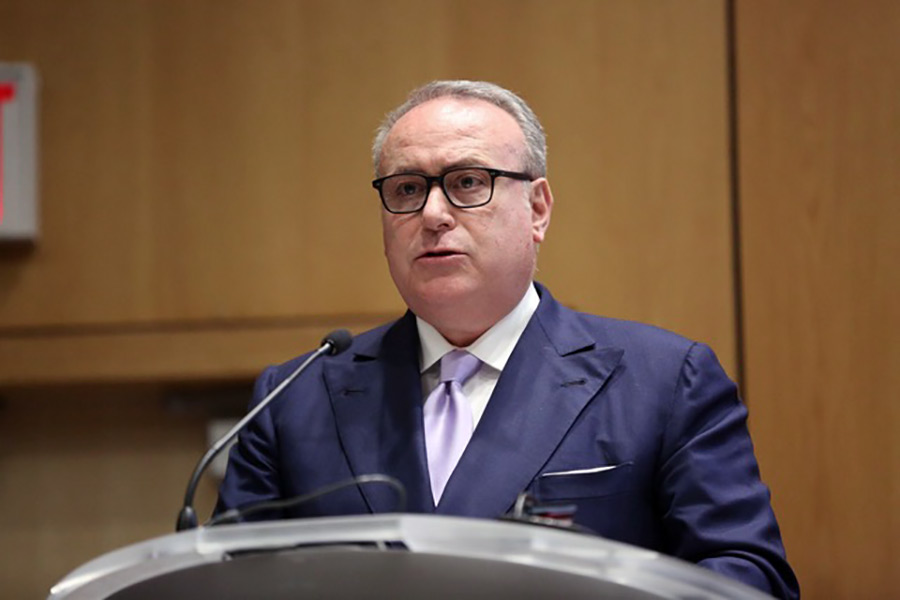
Andrea Mennillo’s Business Ethics Speech made at Fordham University’s Gabelli School of business

Opening remarks
Good afternoon to all of you. I want to thank Dean Rapaccioli for this opportunity to express my thoughts on the delicate relationship between ethics and business.
What is progress?
Today, more than ever, it is necessary to be aware that development must do two things: it must be profitable and it must respect a sound set of cardinal values.
In this digital age, where innovation and transformation permeates nearly our entire society – especially our ways of doing business –we cannot let discussion about progress ignore human behaviors and limits.
This issue is currently being debated by the Pontifical Academy for Life, the Roman Catholic Church institution that studies one of the most controversial ethical dilemmas in our life: science vs faith.
Science is founded on trial and empirical research. Faith is based on religious belief and mystery. So, which is the right path to recognizing the extraordinary progress that science can provide to human lives?
Of course, the right path is the one that is ethical. This is what the field of bioethics studies, and it is one of the more difficult matters that Christianity is debating.
Perhaps you are wondering if I came to the wrong course. Actually, I do know this is the Introduction to Business class taught by Dean Rapaccioli.
You are sophomores and you are preparing yourselves to become business people…in just a few years, you could face a critical life dilemma: the dilemma between greed and value with ethics.
As students at the Gabelli School of Business, you are in the right season of your lives to think deeply about this issue. You have the privilege of studying here and building your character before you confront ethical dilemmas in the daily workplace.
Of course, the workplace now is much different than when I entered it, as a chartered account at Price Waterhouse in the 80s.
The firm that became PWC was only just starting to get into business advisory services. We were mostly accountants and consultants, and there was just one computer in my entire department…we were obliged to share that single computer but also had to protect client information…this was a great opportunity to practice ethical behavior in the workplace.
Since then, almost every aspect of our lives and nearly every industry has been changed by the internet and other powerful technologies.
In very short amount of time, we have evolved to incorporate technology everywhere, but have lost touch with parts of our human nature.
Let’s learn from ancient Greece
Emotions…creativity…imagination…these all can help people to live well together. You know better than me how strongly we are now interconnected through social media but you also know how difficult it can be to share the best human qualities in the digital realm.
I believe that in our current networked society, ethics maintain their own privileged place, as a constant in human life. They are an important guide through the complexities of today.
To think about this, I want to talk for a moment about the past… more precisely, ancient Greece, the birthplace of Western philosophical ethics.
That is where ethical debates began. The ideas of Socrates, Plato and Aristotle revolved around the verb educating, which comes from the Latin words ex (out) and ducere (to lead), to mean bring out; it is equal to developing faculties and powers inside a person – to build up character…
The ultimate purpose of this educating activity was to make people aware they are creators and operators of civilization, and that they are able to shape society, improving it so all can live happily together.
Living well together was the ultimate purpose in the Polis
This is what the Greeks called Eudaimonìa. It comes from the words eu (good) and daimōn (spirit): that was their concept of happiness. Here we can see happiness as a purpose of life and as foundation of ethics.
Happiness had a precise role in directing one's conduct. According to Aristotle, happiness means to live in accordance with complete virtue, not for some chance period, but throughout a complete life. Happiness was an attitude of the soul.
This was the purpose of poleis, the ancient Greek city-states (the most complete form of political organization of Western history). In a polis, "living well" simply was the happiness of citizens, realized by logos, the rational principle that put together and gave a sense to life within the polis. Logos allows us to discuss and decide what is right and what is wrong, what is good or what is bad.
Mirror neurons confirm Greek philosophy
To Aristotle, polis has a very deep meaning. It is a community, a physical presence, a relationship. The community arises to make life possible and to produce the conditions for a good existence. To live individually is not enough.
More than 2000 years later, we can link this idea to a discovery by a renowned Italian neuroscientist, Giacomo Rizzolatti of University of Parma. In the 90s, Prof. Rizzolatti found the existence of mirror neurons when he observed that watching an action and performing that action activates the same parts of the brain, bringing about the same feelings.
Mirror neurons are why you cringe if you see someone slip and fall. They are the bricks of empathy – we all have them. These little cells program us to live in relation with others.
The art of character
Having established that we have a social brain, ethics and the art of working on our own character might be the key to building a more humane society based on mutual cooperation.
In the path of each person's life, there are two variables to consider: destiny, which we cannot influence, and character, which we can work on.
So, let’s talk about character…working on character requires commitment and responsibility. I believe our best guide is the four cardinal virtues: prudence, courage, temperance and justice.
To practice these virtues in our everyday interactions requires us to make conscious choices. They can help steer our decisions and show our limitations.
When greed overcomes character
For example, the financial and banking crisis took shape during the summer of 2007 because multinational banks, particularly in the U.S. and Europe, were unethical in their credit and financial transactions. This spawned a new regulatory framework to enforce discipline and prevent any market disruptions.
But we need to ask ourselves what sparked the global crisis. We do not have to dig deeply to see that too many bankers exceeded their limits, literally and figuratively.
Multinational banks, particularly in the U.S. and Europe, were unethical in their credit and financial transactions. Bankers let ambition and greed overcome their character, ignoring their role in their communities.
Ambition and greed are among what John Maynard Keynes described as animal spirits…human behaviors that motivate us to take on certain tasks.
These behaviors can be engines for our evolution and improvement. But we have to make sure that they don’t interfere our ethics and morals, because that is what leads to our downfall – professionally and personally. In the end, respect and honesty are the foundations for the lasting relationships that get the job done.
Trust is our most important asset
Doing business is a deeply personal activity where trust is the most important asset. Among the four cardinal virtues, prudence called Auriga Virtutum, the charioteer of the virtues, is considered the most significant one.
Prudence gives us the capacity for proper judgment – for applying principles and moral judgment, for allowing us to determine what is good and what is bad. To make proper judgments, you need to be humble. Otherwise your ego will interfere with your decisions.
Pope Francis has won strong support worldwide by emphasizing humility. He says humility is indispensable, but has explained that being humble does not mean being polite and courteous – being humble means being able to accept humiliations.
Accepting humiliation
Michael Milken offers an excellent example of accepting humiliation. At the height of success in the 1980s, the “Junk Bond King” made between $200 million and $550 million per year. Then he was found guilty of securities fraud and sentenced to ten years in prison.
Since he got out of prison, he has worked to atone for his crimes. He is promoting awareness of prostate cancer and raising money for medical research into serious diseases. He has been praised as someone who is helping improve medicine.
Andy Fastow, the disgraced former CFO of Enron, has been traveling around America since he got out of prison in 2011, giving lectures about how easy it can be to fall into unethical behavior.
Of course, it is better to accept our daily humiliations, admit when we are wrong, and avoid forgetting our ethics in the first place.
You can’t live outside the Polis
As you begin to take flight in your careers, there is another classic from ancient Greece that can help guide you. I try to always remember the myth of Icarus, who ignored his father’s warning and flew too close to the sun. Icarus overestimated his capabilities to the point that he lost touch with reality. His Hubris…his pride, stemming from privilege and power, ultimately led to his downfall.
To have the guts to admit to your own weaknesses and, unlike Icarus, to be aware of your own limitations is what will set you apart as you work towards your hard-earned successes. It is important to keep your pride in check with what the Greeks called Metis: wisdom and, again, prudence.
Ethics and business are not contradictory aspects of life – they are the winning path to sustainability. The challenge today is to prepare ourselves to be women and men with a sound set of cardinal values as well as financial notions and entrepreneurial spirit.
Remember, according to Aristotle, only angels or beasts can live outside the polis…we are mere women and men!
I want to leave you with this insight, and am happy to open the floor to your questions.
Thanks to all of you!
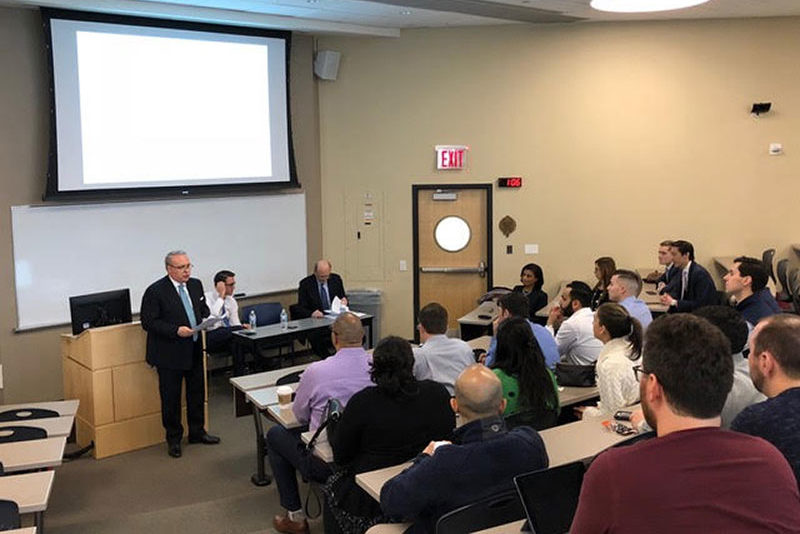
Andrea Mennillo’s opening speech on financial services in Europe made at Fordham University’s Gabelli School of business

Introduction of panelists
Good afternoon, and welcome to this timely event to discuss financial services in Europe.
Before we begin, I would like to congratulate with Dean Rapaccioli and her team for the growing success of these International Business Weeks. I firmly believe that the global approach we are discussing is vital for success in business today.
It is an honor to be on stage here two with respected leaders of the financial services industry.
Stefano Marsaglia, Executive Chairman of Mediobanca, has done it all over his thirty year career and Greg Minson, a Managing Director of Goldman Sachs, has also seen more than a thing or two since he got his bachelor’s in economics in Fordham 20 years ago.
Stefano and Greg, thank you both for taking the time to be here today.
It is easy for me to introduce Stefano and Greg – they have been my friends for a long time. I want this to be a more relaxed, informal panel where the whole audience feels welcome to participate in the debate with questions and comments.
Please take advantage of this discussion: experienced managers like Stefano and Greg have enriching insights about international business. Moments like this are an opportunity to learn from their concrete, daily work in this sector. Let’s be inspired by these two extraordinary experts.
The financial services market: Its dynamism and innovation can’t be turned off…
As a veteran of the financial services industry, I have experienced its innovative attitude. But well before my time, it has had a key role in the evolution of our society.
It goes back to the ancient Romans, who had to finance agriculture and wars, and the XIII century, during the period of the maritime republics, when the first banks were born.
If you Google “world’s first modern public bank,”1 you will read about Banco di San Giorgio, which was founded in 1407 in the Italian port city of Genoa.
Banco di San Giorgio was so powerful that Niccolò Machiavelli, the author of The Prince and father of modern political science, once described it as “a state within a state.”
Even in its early stages, evolution existed in the financial services industry. At first, banks mainly focused on trade and merchant transactions. But they soon became complex institutions that managed numerous complicated business streams.
Not long into my career, I had the opportunity to work for a medium-sized Italian bank led by a visionary CEO that allowed me, as part of the senior management team, to turn a local bank named BIPOP into one of the world’s largest online financial institutions.
Through its subsidiary, Fineco, BIPOP delivered triple-digit growth in asset and net profit for five consecutive years. In that time, its market capitalization jumped from €300 million to more than €20 billion, thanks to a business model that took advantage of innovations in online and multichannel distribution.
Based on that success, I firmly believe in innovation.
Later, I became CEO of La Centrale Merchant, a financial institution that had two large insurance companies as main shareholders: Generali from Italy and Allianz from Germany.
When I was in that position, Italy’s finance minister at that time, Giulio Tremonti, appointed me to the Experts Committee of Cassa Depositi e Prestiti, the biggest bank for infrastructure of the world.
Today, I still work doing advisory on infrastructure in high growth countries. Some call this activity “business diplomacy,” which I think is quite accurate because it requires balancing the needs of a wide number of stakeholders.
With regards to the financial services industry, we should remember the US and Europe chose different roads.
In the US, when President Clinton canceled the Glass Steagal Act in 1999, it allowed financial institutions to carry on both traditional banking and investment banking. Meanwhile, in Europe, these two businesses remained separate.
Yet financial services remains one of the most dynamic sectors of Europe’s economy. And in recent years, this sector has probably seen the largest number of unexpected changes in its history.
Probably you are immediately thinking of the consequences of the financial crisis that began in the summer of 2007… Yes, indeed this is one of the changes I am talking about, but not the only one. Not all of them were so negative…
Using a car race metaphor, I see the financial crisis as “only” a very tight curve taken at high speed. You do not necessarily go off the road; it depends both on the car you are driving and on your skills as a driver.
For example, look at what happened to derivatives in mid-2007. In the middle of the race, while the financial service market kept the accelerator down to move quickly towards new goals, the US ABS market suddenly collapsed, and derivatives market with it.
But this did not end the race … Certainly all financial institutions were shaken by this crisis, but as some fell down, others grew quickly by adapting to the new scenario. This illustrates the dynamism of this market.
A decade later, we can see that the derivatives market did not die. It is more active than ever. In the European Union alone, it reached an estimated notional value2 of more than €450 trillion at the end of February 2017.
In fact, we should now see even more clearly that derivatives are instruments for addressing business uncertainty, and not are an absolute evil. Of course, it depends on how you use them.
Apart from dynamism, innovation is an important feature of this industry.
Every day, new financial products are invented to meet the broadest range of needs. These new products widely vary in types, risks and complexities, but they are all pivotal to making business work.
Think about digitalization, which now is the leading trend in financial services. Immediacy, simplicity and automation characterize this digital age – financial services must achieve these qualities in their offer. It is not by chance that we are now experiencing the explosion of digital currencies and transactions thanks to the new, revolutionary blockchain technology.
Innovation represents the ability of this sector to continually revitalize itself, to always rapidly answer changes in the needs of market and clients, whether they are big or small companies, investors, individuals, consumers, governments, or public organizations.
Regulation and competition: Threat or opportunity?
But the most relevant words for this sector are regulation and competition.
Let’s talk about regulation. Over the last 15 to 20 years, we have seen how regulators have gradually become stronger, building a “fence” around the financial sector to avoid new crises and market shocks. This is especially true for Europe, but also at the global level.
In terms of international rules, we have the Basel agreements (the first in 1988, the last, Basel 3 in 2010), proposed by the Basel Committee, representing the central banks of the G10 countries, with the aim of giving clear international rules in bank supervision and aligning banks capital requirements at the international level. This was mostly necessary, considering the rapid process of globalization of this sector.
Personally, I began to better understand the impact of capital ratios when I was in the Strategic Management program at INSEAD in Fontainbleau. One of my Professors was Jean Vermine, who was a member of the commission in charge of introducing Basel 1 rules in Europe.
These rules are deeply rooted in Europe’s banking culture. The Basel 3 agreement in particular dictates liquidity and capital ratios, capital adequacy and leverage. The aim of the regulators is to control risks and mitigate losses. In short, the higher a risk the bank takes, the higher the capital the bank must have.
This has had a heavy impact on banks, making them more selective in granting credit to enterprises and therefore reducing their support for the economy.
As a consequence of Basel 3 rules, banks were obliged to improve their compliance and risk management processes, making them much more effective.
But, above all, banks were obliged to reduce leverage and to reinforce their capital. This meant:
- raising new capital on the market3
- requiring higher credit rating from clients
- selling bad assets4 like NPLs
- selling assets with high capital absorption, exchanging some business for cash
Consider that as soon as Basel 3 was communicated, European banks reduced their leverage ratio (measured as assets to equity) from an average of ~29x to 25x.5
In addition, to reinforce their capital, many institutions were forced to merge, which fueled the M&A market. Stefano will soon dive into this important topic.
On the other side, capital pressure created another important market. Recently we have seen the explosion in issues of NPLs as a legacy of years of economic slowdown. As a consequence of regulation, intermediaries were forced to get rid of the problematic assets.
The consequence was the arrival of operators who specialize in professional management of this type of risk, giving prompt support to the stability and profitability of the banking sector that was pressed by bad loans.6 These players are buying NPLs and creating value from their profitable management.
Here, we are benefiting from Greg’s experience, as at Goldman Sachs he created a successful business area completely devoted to NPL management.
But the total volume of NPLs across the EU is still very large, at €950 billion, so I think there is still a lot of work to do for people like Mr. Minson and his colleagues…
…and for his competitors, of course. As I said, the financial services market always offers good opportunities and will remain interesting for many new players.
Financial services are becoming a very crowded arena of different operators compared to several years ago. Traditional players are now facing newcomers from China and the Middle East. Countries that were not in the business until a few years ago are now dangerous competitors.
But this is what globalization means….
This is only one side of the coin, because on the other side of the coin we have increasing competition resulting from new technologies. We are living in the era of block chain, virtual currencies and FinTech.
The use of data and analytics to predict client needs, improve processes and services, and prevent fraud is becoming more common than ever.
Technology also brings more disintermediation. New players in the market, like Apple pay, Paypal and others offering complete “financial wellness platforms” are allowing clients to budget, bank, pay, and crowd-fund with their smartphones. Moreover, sometimes these players are not affected by regulation as traditional providers (so-called shadow banking).
But this is what digitalization means…
Competition and regulation are both positive tools for the efficiency of financial services markets, but of course rules must be equal for everyone and guarantee that competition goes for the benefit of users.
What’s the future?
In the global market, I think that Europe will remain the point of reference in this sector, regardless of Brexit.
FinTechs are for sure an opportunity for the entire economy: for retail users, for businesses and for traditional financial players.
In this sense, I firmly believe that we will see an increasing collaboration and alliance between more traditional players and new, innovative ones.
Of course, there remain risks and threats in the financial services market. They cannot be addressed just with rules or technology … what is needed are skilled, responsible managers who can combine attention to value with ethics.
Our esteemed panelists here are among the best guides we have for an overview of financial services, but they are also models of responsible managers.
So, Stefano, Greg … what can you tell our young audience about the next big changes in the financial services industry? For example, does technological change mean hard times for banks, or do you see a winning alliance between traditional banking and innovative services? What, in your opinion, are the main trends we will experience in this market?
Greg, Stefano, I leave you the floor…
1 www.ft.com/intl/cms/s/0/6851f286-288d-11de-8dbf-00144feabdc0.html#axzz2ycmbeCR9 “The World’s First Modern, Public Bank,” Financial Times Magazine. April 17, 2009.
2 Source ESMA: https://www.esma.europa.eu/press-news/esma-news/esma-produces-first-overview-eu-dernplivative-markets-size
3 Since 2014 to end 2017, banks in the euro area have increased their capital by EUR 234 billion and added EUR 813 billion of liquid assets. Source: European Commission
4 The average ratio of NPLs has decreased by one third since 2014 and is on a steady downward trend. Source: European Commission
5 Source: Bank of Italy Occasional Papers, “EU bank deleveraging”, September 2014
6 At mid 2017, the NPL ratio of EU banks declined to 4.6% (Q2 2017), reaching the lowest level since end 2014 Source: European Commission

Five questions for Andrea Mennillo: "After Brexit, can Europe still warm hearts more than it stirs passions?”
Brexit is officially underway. This month, the British ambassador to Brussels gave Donald Tusk, Chairman of the European Council, the letter signed by British Prime Minister Theresa May that formally gives notice the UK will withdraw from the European Union. Nine months after the referendum, this was the first act of procedure to trigger Brexit. While some had hoped for second thoughts, as the British Prime Minister said, "We do not go back."
A few days after the celebrations for the 60th anniversary of the European Treaties, Dr. Mennillo was interviewed about the future of a united Europe. Below is an excerpt of the interview.
1. Dr. Mennillo, when we last spoke about Europe, the results of the British referendum has just been announced. Today, Brexit is becoming reality. It seems that, for some years, European integration has stirred passions more than it has warmed hearts. How do you see Europe's ideals today? Are they still realistic?
Europe has certainly become a hot topic. Much has been said, and we will continue to say much more. Before discussing why I believe the European ideal is still realistic, I would like to reflect on the original meaning of the EU. At the end of the last world conflict, it was clear to European countries that they could only achieve peace and prosperity in the long run if they stayed together. This conviction led them to sign the Treaty of Rome, concretely unifying the concept of common values and cultures born in the previous century, with the belief that they can combine independence, peace and freedom. Since then, Europe has had numerous achievements, from free circulation to the introduction of a common currency. The founding ideals, which have given us seventy years of peace, stability and welfare -- the longest in our history -- do not deserve to be set aside. On the contrary, now it is time to re-launch these principles and move towards greater cohesion between countries, because we are at a very delicate historical phase, which is also characterized by the continuing terrorist threats.
2. Why do you think it is necessary to complete the integration process? And what will be the right balance for you?
In the geopolitical context, I do not see many alternatives to a united and integrated Europe. Economic equilibriums are already changing to our disadvantage, and the gaps are likely to widen. The colossuses, China and India, will be increasingly "heavy" at the economic and demographic levels. I would be surprised if, in 30 years, Europe’s total GDP weighs more than 10 percent of global GDP.
Let’s also think in terms of demographic dynamics: In 2050, in a world of 9 billion people, all the European nations together will not reach 10 percent of the global population, compared with 20 percent in 1950. And by then, no nation in Europe will alone count for more than 1 percent of the world population. This is data we always must keep in mind.
3. Since the Brexit vote, the Dutch avoided the danger of electing an anti-EU party and in France, Macron was elected over Le Pen. Despite these electoral defeats, nationalist anti-European sentiment seems far from weak. How, in your opinion, does the EU provoke such hostility?
Establishing the euro does not mean you have defined Europe. This was easy to see from the beginning, but a single currency is not enough to stimulate a sense of the European people. Collective identity is what is missing today in this Europe – to build it, we need a political and cultural project that citizens can identify with. I think this topic of identity has now become a priority. The EU is saddled with strong controversies, which in many cases are likely to turn into real fractures. Economic differences and the fears they create make dialogue difficult – they undermine relations among states. Northern countries refuse integration and solidarity policies, while protests against austerity policies are growing in the southern countries, where more solidarity is desired. In this context, European institutions remain distant from the places where citizens face difficulties in their everyday life, while the political system is judged incapable of diagnosing problems and doing what they have promised. There is therefore an urgent need for reconciliation between the EU and its citizens, since achieving consensus is indispensable for a sound democratic future.
4. We have talked about problems so far. What are, in your view, the strengths that provide Europe leverage?
A true "union of forces" would be a great multiplier of effectiveness, transforming the Europe’s specific skills and know-how into real competitive advantages. Europe has always distinguished itself for the quality of its intellectual capital. Just think that in 2003, 22 percent of patents worldwide came from European countries. Today, this percentage has decreased as other countries have developed, demonstrating how the global scenario is rapidly changing and requires constant effort to stay in position. I think that if all European Member States pooled their superior advantages in each sector, Europe would not be afraid of confronting anyone. It is about discovering and enhancing the richness embedded in the diversity of each country in the Old Continent.
5. What about the future? Do you believe in the United States of Europe?
The future will depend on how well European institutions can meet the needs of the citizens, and how much individual Member States will set aside their own interests for the interests of the community. However, I do not think it will be easy, because Europe’s history is very different from America’s. From this side of the ocean, we have at least 2,000 years of divisions among people and cultures that are profoundly different each other. Beyond the Atlantic, the glue was created 500 years ago and it is still strong. Back then, it was about building a nation on a new territory, and today it is about making that nation increasingly secure and durable.


Five questions for Andrea Mennillo: "After Brexit, is the destiny of Europe and the global economy in the hands of the British?"
When the British voted in June 2016 for the UK to leave the European Union, they made a choice that changes the destiny of the continent and has a significant impact on the economy, perhaps around the world. Brexit puts the entire European project into question and has invigorated eurosceptic political parties. A few days after the surprising referendum result, we asked Andrea Mennillo for his opinion on possible future scenarios.
1. Since the eve of the vote, there has been vigorous debate about the possibility the UK will exit the Europe Union, and much else has been said about the result of the referendum. Is there too much panic or is there really something to worry about?
The result of the referendum was a reason to celebrate for the eurosceptics throughout the Old Continent and, as expected, it sent a shock wave through European financial markets and forecasts for its economy. That probably happened because of the storm of different opinions that are each concerned with different positions. The news of the "Leave" victory was enough to cause a sudden collapse of the pound on the dollar, with losses over 10 percent -- a record drop in the last 30 years. The main European stock exchanges were hit by losses due to market uncertainty. Milan closed at -12.5 percent, its worst result in recent decades, while the London Stock Exchange closed at -3.15 percent. But let's consider real political facts: The British people have democratically chosen to leave the European Union. One can agree or disagree with the reasons that led to this result, but now it is time for the British government to follow the popular will. Certainly the exit of the UK will not be without economic and political consequences, some obviously negative. However, I would like to point out that what has happened is mostly symbolic. The European Union is not something eternal and untouchable -- it is an institution that can be modified. This is the message the British wanted to send. From Europe, you can enter and exit, and European integration is not always beneficial.
2. Dr. Mennillo, you seem to be favoring Brexit....
I neither favor nor oppose it. I just take into consideration the result of the vote. We cannot live with the firm conviction that our certainties are eternal. We must remember that important changes can happen in any time, including the upturning of the status quo. History teaches that to us. How many times has the unthinkable happened? Let’s think about the two world wars not many years apart, or the technological revolution that has led to the globalized world. Almost anything can happen, so let’s keep in mind that there will be inevitable economic impacts, and also political ones, especially with regard to European unity.
3. In your opinion, what could be the foreseeable consequences for Europe?
There is not too much we can predict at the moment. We are in the field of conjectures. To avoid further uncertainty, the presidents of the European Commission called on the UK to leave the EU "as soon as possible, however painful that process may be." However, the process is expected to take a long time, and it will be a couple of years before the operation is completed. At this initial stage, uncertainty is high due to many factors. What will be the future relationship between UK and rest of Europe? The old equilibriums will be replaced by new ones, and the reorganization process may not be without pain for everyone. But I do not think the catastrophic scenarios will happen. Just to give you an example, we talk a lot about financial institutions running away from London, which is today the most important financial center in the world. However, I do not think we will see a mass migration of grey suit bankers. On the contrary, many would be ready to deal with British government, considering the huge costs they would incur for moving elsewhere. If the UK negotiates an association agreement with the EU, such as the ones with Switzerland and Norway, where the sharing of large parts of the Single Market is a reality, the medium-term economic consequences may be not so relevant for all parties involved.
4. In your opinion, how will Europe’s international status change without UK?
It is hard to say. Having lost an important country like the UK, it is easy to imagine a weakening of Europe. But Brexit could turn into an advantage: With the awareness that others could follow the example of Britain, member countries may find that although cohesion seems to be cracking today, it may result in giving more strength to the union. Although it will be difficult ... we see how the EU is, for example, incapable of creating a common plan to handle the number of refugees coming from the Middle East and Africa. It also proved incapable of offering sensible solutions to the economic crisis in Greece. How many states will be willing to accept these shortcomings for the sake of an inconsistent Europe that also does not grow economically as it should? The new grounds for relations between the UK and EU will, of course, depend on delicate political negotiations. If London is out, many companies could decide to leave the country to continue to benefit from the EU market. On the other hand, it may happen that London remains, is excluded from European institutions, but is fully integrated into the European market. However, in that scenario, it would have no leverage to influence the economic processes in which English people are included. In all this, there is also the burden of the United States and the forthcoming presidential elections. But the future is open to all possibilities.
5. Finally, what do you think the consequences are for Italy?
Much will depend on what new equilibrium is achieved. In the short-term perspective, the estimates are for the UK to experience a reduction of 3 to 5 points in GDP over the next 12 to 18 months, which could have an impact on Italy. Great Britain is in fact our fourth largest market for exports, albeit with a small share (around 5 percent of total Italian exports). However, it is possible that if the UK were no longer a convenient market, Italian trade would be repositioned quickly and at a lower cost to other countries. In addition, Italy could benefit from new investment opportunities from those who will leave Britain to re-orient their positions towards the continental market. Therefore, it will be important to become a more attractive destination to capture this re-allocated capital.

Five questions for Andrea Mennillo: "The "New Silk Road" will bring China and Europe closer”
Among a number of economic and financial trends in Europe, the growing enthusiasm for China and its development policies warrants careful examination. Over the past decade, the Middle Kingdom has steadily increased in competitiveness, and it now appears poised to displace the US-led West as the leader of the global economy. Read more