


“Sovereign Debt: A Looming Debt Crisis?” with Anne-Laure Kiechel
Here below the recording of the conference organised by Gabelli School of Business on last June 22nd. Dean Donna Rapaccioli and I had the pleasure to discuss with Anne-Laure Kiechel, Founding Partner of Global Sovereign Advisory, about “Sovereign Debt: A Looming Debt Crisis?”.

“A Case Study: European Financial Institutions During and After COVID” with Domenico Siniscalco
Here below the recording of the conference organised by Gabelli School of Business on last June 8th. Dean Donna Rapaccioli and I had the pleasure to discuss with Domenico Siniscalco, former Italian Minister of Finance and current Managing Director and Vice Chairman at Morgan Stanley, about “A Case Study: European Financial Institutions During and After COVID”.

“Down and Under: The Pandemic’s Impact on the World’s Oil Industry” with Paolo Scaroni
Here below the recording of the conference organised by Gabelli School of Business on last June 4th. Dean Donna Rapaccioli and I had the pleasure to discuss with Paolo Scaroni, former CEO and General Manager of Eni Spa Oil and Gas and current Deputy Chairman of Rothschild & Co, about “Down and Under: The Pandemic’s Impact on the World’s Oil Industry”

“Entrepreneurship and the Future of the Online Luxury Retail Market” with Charles Gorra
Here below the recording of the conference organised by Gabelli School of Business on last June 2nd. Dean Donna Rapaccioli and I had the pleasure to discuss with Charles Gorra, CEO and Founder of Rebag, about “Entrepreneurship and the Future of the Online Luxury Retail Market”.
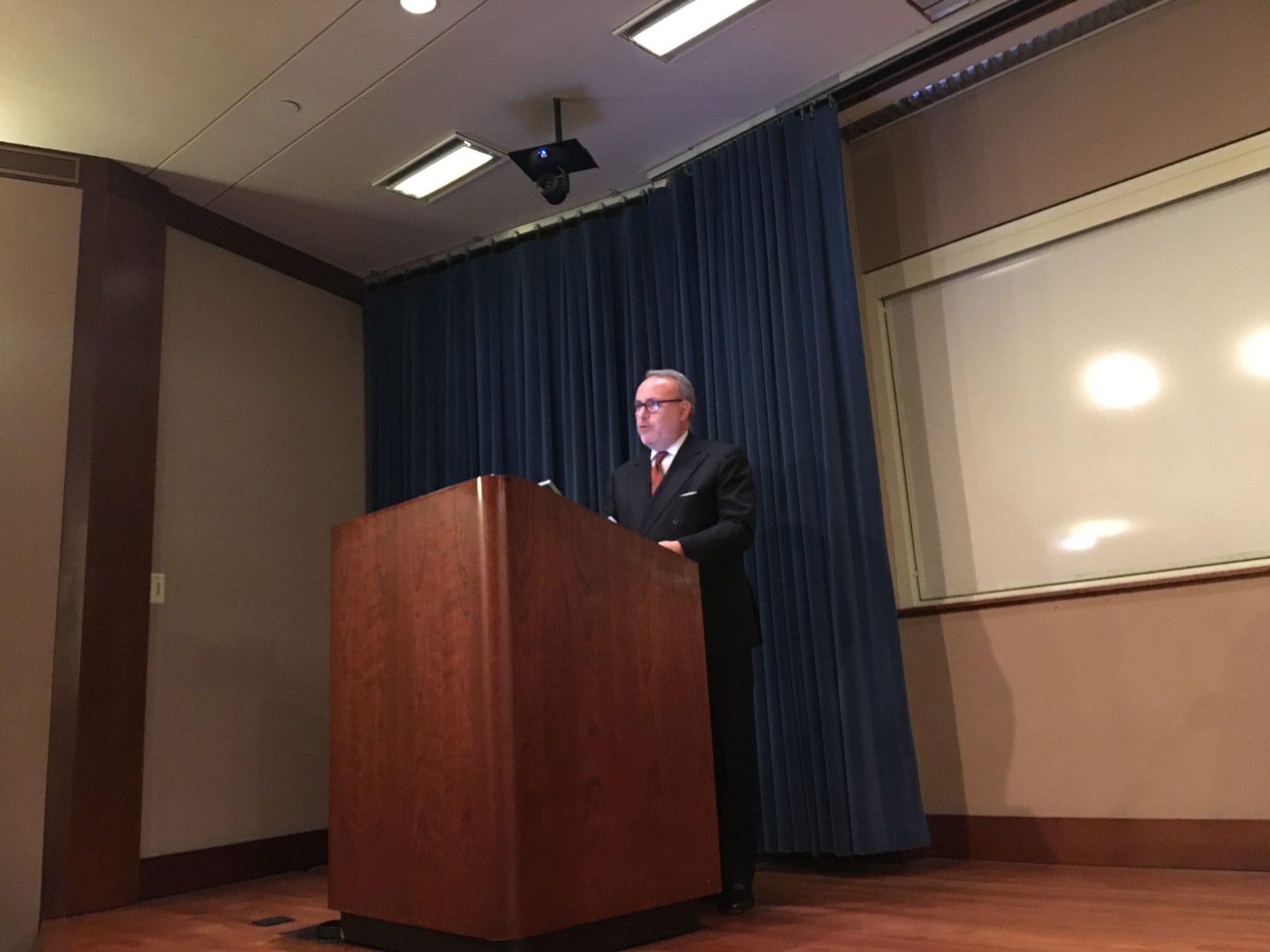
Andrea Mennillo’s speech on “Geopolitcs: its Impact on Global Business” Made at Fordham University’s Gabelli School of Business.
Fordham University – Gabelli School of Business
Lincoln Center, October 24, 2019
Opening Remarks
Good afternoon to everyone. As always, I want to thanks Dean Rapaccioli for her usual willingness to give space to meetings with strong and concrete international view.
I also want to thank Father McShane and Rev. Vincent Decola for their sensitivity for giving green light to these conferences with an international perspective. Today we focus on geopolitics.
We are here today because it is important to enrich our personal cultural background starting from knowledge and study.
The objective is to understand what happens around us gathering information from day by day reality around the world. It is crucial to know more about international politics and international relations and related impacts on business activities.
These are just insights that apparently seems very far away from us but – on the contrary – they are not, because have great consequences on the way we do business.
Business is global now. Talking about impacts, let’s think about for example to the relevance of trade agreements, to oil prices changes during conflicts, etc…
So, welcome to everyone, and thank you for being here with us.
Geopolitics and globalization in the digital era
Geopolitics and globalization are two concepts that it is important to clarify because they are strictly connected. First of all, what does geopolitics mean?
Geopolitics is a recent word created to define the complexity of relations among states in the modern era.
Rudolf Kjellén, a Swedish political scientist, was the first to use this word at the beginning of the 20th century and it came into worldwide use during the World Wars.
Geopolitics is the union of two Greek words – GEO + POLITICS – where:
- GEO means Hearth and this has to do with a global idea which oblige us to turn this ancient word into a more contemporary one that is “international”;
- POLITICS comes from Polis, that means “affairs of the cities”(according to Aristotle’s ideas), defining the set of activities associated with the governance of a country, or an area.
Finally, Geopolitics is the analysis of the relation of international political power to the geographical setting. Here we come to globalization.
Thecurrent context is strongly dominated by interculturality, complexity and dynamism.
Globalization is not a phenomenon that is born today but has always existed and over time took on different connotations depending on the historical period.
Todaythe rapid growth and spread of new information technologies applied to telecommunications reduces even more distances between countries, both referring to economic activities and to everyday life.
The “winners” in this current scenario are all the companies that:
- deal with the physical transfer of goods (see Amazon, for example);
- sell intangible services through the network (see big internet companies, for example).
However, we have to consider the reality, made up by different countries, boundaries, commercial treaties, fiscal rules, payment systems, tariffs, customs duties and taxes (direct and indirect).
Some of the main international economic agreements in force are:
- NAFTA(North American Free Trade Agreement) which is going to be replaced by the USMCA (which includes Mexico), introducing the progressive elimination of all tariff barriers among countries within the agreement;
- therecent Europe-Japan agreement;
- theWTO rules;
- CETA, the agreement between the EU and Canada;
- MERCOSUR, agreements among South American countries;
- bilateral(increasingly widespread) and multilateral agreements;
- freetrade agreements;
In this global arena we have to think about criminal actions so there are set of laws and procedures to preventthem.For example those rules related to anti-money laundering. US imposed the Foreign Account Tax Compliance Act (FATCA) to foreign countries that want to make business with US citizens in order to contrast tax evasion. These rules were necessary to manage great growth of international transactions.
Today it is important to be informed on what is happening around the world (in USA, there seems to be very little general interest in what happens outside), because event now has global consequences, even in real time.
There are important examples of globalization that come from the past (religious and territorial).
In our Jesuit tradition we have two important men to remember, both consistent with Ignatian spirituality and its missionary dynamism:
- Francis Xavier, was born in XVII century (1506), he brought the Christian message throughout Asia (in particular, in Japan and in India). Francis Xavier together with Ignatius of Loyola was co-founder of Society of Jesus. He is Patron of Catholic Missions;
- MatteoRicci, who in the 16th century dedicated his mission to the Christianization of China, fully penetrating the Chinese culture and learning language, tradition up to become a leading representative of the imperial court, esteemed for his great experience, and thanks to this he still be remembered in China even today.
As you see, the evangelical message was the first global message. Francis Xavier and Matteo Ricci are here great examples.
Coming back to the past means learning from who came before us, means contemplating and always having in mind valuable experiences.
The playground is the world and in our daily business life it is important to know who passed the baton to people like Father Mcshain and Rev. Vincent Decola.
The same Ignatian spirit today requires from each of us “… the willingness to participate in social and political life and to develop our human qualities and professional skills to become more competent operators and more credible witnesses”(from Principi Generali della Comunità di Vita Cristiana del 1998). Once again this message tell us that it is important to acquire the necessary knowledge around us, to become a bridge between diversity.
Here in Fordham we must be the first who are able to understand this kind of messages. Knowing history means that we should understand the globality of Jesus‘ message. A message wich is does not closed within borders.
The Christian faith is -in fact- an inclusive concept, it is an attitude of reciprocity and openness towards the others which goes beyond political and cultural boundaries.
An other example of globalization, this time a territorial one, is the Roman Empire expansion, which I often like to mention in my interventions: from a few huts near the Tiber river, it expands throughout the Mediterranean and Europe.
Rome was one of the first multi-ethnic and “global” state.
Its open society leads it to attract various Italic people and to integrate its cultures into a unique “melting pot”, from which was born a state capable of assimilating external elements, enhancing them and expanding itself to the borders of the world known at that time.
Geopolitics and Diplomacy
Why is geopolitics so important? Geopolitics, even if involves different disciplines – such as history, geography, anthropology, economics and others – is not a science, but rather the study of specific cases, where there is competition for a territory and for projects.
The keywords are always dialogue and confront. In all ages. Activities traditionally delegated to diplomacy and ambassadors.
But what is diplomacy and who was the ambassador?
- Diplomacy comes from the Greek verb „diploun“ (fold in two). During the Roman Empire the imperial documents, as „passports“ and transit permits, were fixed on double metal plates, folded and sewn. These documents were called “diplomas”. Later, this name was used for all the official documents. The use of the terms “diplomacy” and “diplomatic” dates back not earlier than 1796, when in England Edmund Burke began to use it by designing “the set of political-institutional procedures through which states maintain relations with each other”. Starting from 1815, after the Congress of Vienna, the diplomatic service became a real profession distinct from the politician, thus acquiring juridical value with norms and prescriptions;
- Geography is related to diplomacy: in the past borders were mainly set by nature (rivers, mountains, seas,…). Then borders were sometimes decided by politics without taking into considerations people living over a specific land. A fact that is often a reason for conflict;
- See for example: Kurds is an ethnic group composed of 50 million people divided (by politics) in five nations such as Turkey, Iran,Iraq, Syria and Armenia. The Kurdish diaspora is similar to other ethnic group such as the Armenians. Today Kurdistan is not a State but is a region with geopolitical relevance. In Syria and Iraq they have gained a special status; in Iran people live peacefully but in the other countries they are fighting;
- Current news makes us well understand what today’s geopolitics is. See revolutions currently open all around the world.
Ambassadors were spokesmen and reported to their sovereign. They represent their own country in other states, where they are in charge of conducting negotiations and maintaining relationships. The importance of this role, is demonstrated by the fact that it is the highest office among the civil servants (the appointment as ambassador is the highest honor a citizen has received from his country). In fact, in the republics they had a superior authority to that of the royal correspondents. In the second millennium, the countries with the largest diplomacies were: France, Spain, UK, Vatican City.
Today, technology has changed their role. The web has made relationships faster and more direct, even among Presidents and Prime Ministers. The role of diplomacy has therefore become more commercial oriented.
In the current global scenario it is therefore important to learn to relate and to reach points of convergence.
It is not by chance that ambassadors were political experts, trusted, cautious and with diplomatic ability.
In this context, arises the value of a profession that I know well as Business Diplomacy.
It consists in establishing and sustaining positive relationships with foreign government representatives and non-governmental stakeholders (economic and non-economic) with the aim to build and sustain legitimacy in a foreign business environment.
Business diplomacy is a way to seize opportunities in the current globalized world. It requires a set of important competences such as cross-cultural communication skills, interpersonal influence, empathy, networking abilities, adaptive thinking, resilience, knowledge of country’s culture and traditions.
In business diplomacy, what opens doors for multinational companies worldwide is an individual’s ability to build trust with rulers, decision-makers, entrepreneurs and leading figures in foreign institutions – even where such opportunities come intertwined with complex challenges and barriers to entry.
In business diplomacy, it is one’s reputation, diplomatic talents, and deep study of the country that make creating important opportunities.
Geopolitical poles
In this globalized world it is fundamental to be able to analyze international equilibrium from a wide perspective.
During decades (years 1950, 1980, 2000, today) the first 5 countries ranking for GDP, population and military expenditure has changed, reflecting changes in world balances.
I see 6 big areas of power/influence
- Three main leading countries: US, China and Russia. They are the strongest economies of the world with the most powerful armies.
- Russia has a leading political influence, but a lower economic power than US and China. It ranks 5th in the world by GDP;
- But they are very different countries in terms of government systems (only US is a democracy);
- Russia is a huge country, it starts from Europe and covers a very big part of Asia: Vladivostok[1], a Russian city placed beyond the Eastern part of China and in front Japan – is 8,30 hours fly from Moscow, vs nearly 5 hours from Los Angeles to NY;
- Can you imagine the difficulties in governing such a broad country, with so many differences among areas?
- Today in Russia there is a President on power for 22 years. In 1997 Boris Yeltsinappointed Putin deputy head of the Executive Office of the President;
- We do not know too much about what happens in Russia. Considering the foreign policy – from the European point of view- Russia has a very active role, as it is our neighbor;
- Currently, USA and China are playing a “trade war” in order to gain the hegemony of the global market.
- Europe. It is the area that seems to have more stability.
- European Union is facing several internal troubles and it has to do with populism. So foreign policy is influenced by internal politics;
- If Europe is home of democracy and through cultural illuminism its structure shifted from dictatorship to democracy, today Europe is living a difficult moment. Differencies among political choices and people values are increasingly generating mistrust;
- Brexit docet. Today there is a big confusion that should lead to irreparable damages (even if UK decides to come back);
- From political point of view, it can be considered an unsuccess, even if economically it is the only way;
- Relations between member states are not fluid and it is difficult to find a common view on many topics affecting internal and external affairs (migrations, economic policies, public accounts);
- Now it is facing the issue of Brexit, in order to find a balanced agreement with UK;
- It is important for the EU to be able to open a dialogue with Russia, its most powerful neighbor.
- The American Continent, in particular South America that has been freed from colonial control just one century ago
- Venezuela is one of the main oil producers in the world. Its wealth sudden increased, but it is very polarized in the society;
- Brazil, Argentina and Chile have natural resources but are most controlled by foreigners and are not so evolved in terms of citizens’ quality of life standards and of democratic processes;
- Canadais a big country, which needs to be contaminated from outside. Culturally, it is very much connected to the European world and for some extent even more then to the US;
- Mexico is a country that needs regulation. Its immigration brings not only workforce but also brings a sense of aggregation and social values as family, according to Christian values.
- Far East. The Asia-Pacific region is still seeing a quite powerful economic growth.
- Japan created the third largest economy in the world after the war, even though it is now losing ground due to the rising of other countries of the region;
- There are some emerging stars, like South Korea, Indonesia, Vietnam and the Philippines;
- India, after recent elections is now looking for economic stability that, the new government will have to reach through reforms;
- This area has differences in political and economic systems, in the culture and in the religion (most people are polytheists);
- It is an area where conflicts still exist.
- Middle East. An area that was controlled by the British until 50 years ago
- Composed of countries (e.g Kuwait, Qatar, Oman) whose economy was traditionally based on trade, but then oil changed equilibriums and relationships. They are countries governed by emirs with absolute power
- Israelis is surrounded by hostile countries. Alliances are so changeable that this could push to an alliance with Saudi Arabia
- Now the scenario is much more complex and the focus is on the conflict between Sunni and Shia feeded by autocratic governments and Islamist movements
- Lebanon is a small country but it is crucial for the equilibrium of the area. It has a great history. There is a strong Shiite community hostile to Israel. The Sunni and Maronite Christian presence is lower. If Lebanon is in equilibrium, this is also valid for the rest of the region
- Lebanon, Israel and Iran are the only countries where elections exist.
- In Lebanon, the situation is evolving in Beirut. The attack of the Turkish army in Syria is maybe putting under pressure the south of Lebanon. We have to add scandals involving president Hariri and poverty among the population
- Africa. It is the most interesting area of the world in terms of potential
- Africa is now living an ongoing industrial revolution, and it has great unexploited resources;
- But there are many obstacles for enterprises in sub-Saharan Africa, such as access to finance as their biggest business obstacle, energy and political instability;
- Life standards remain very low. More than half of the extreme poor live in Sub-Saharan Africa. The number of poor in the region increased by 9 million (1990-2015), with 413 million people (on total of 736 million poor people in the world) living on less than US$1.90 a day. If the trend continues, by 2030, nearly 9 out of 10 extreme poor will be in Sub-Saharan Africa;
- In particular, Nigeria will be the rising star of the next future. It accounts more than 200 mln people (the same of Brazil, or 2/3 of US population, or Germany + Japan population).
Values and knowledge for profitable international relations
As you can see, we are not alone in this world … we are always surrounded by relationships and we have seen how humans have a strong exploratory nature. Since ancient times they felt the need to move from their birth areas to explore and learn about new places …
We are all result of a continuous cultural contamination and I think that each one of us has the right to express his thoughts.
It does not mean to come into conflict. You are free not to accept someone’s else vision, but you have the duty to understand him.
If you are here it is because you embed the values of this institution. One day you will be a leader and, so you have the duty to be informed. A leader must start from here, from study, because study is the bearer of cultural, economic, ethical-religious values.
Knowing and understanding allows us to have profitable relationships and to make alliances, respecting different cultures, different values and different religions. Values are the compass for finding one’s way in this world of diversity.
Ancient civilizations have laid the foundations of our being, bringing specific peculiarities and common traits. For the Western world the references come from classical Greece and the Roman Empire.
The concepts of polis and happiness for the Greeks, where polis means respect of the rules, even moral, of coexistence with others and the right to the pursuit of happiness …
About happiness: This is what the Greeks called Eudaimonìa. It comes from the words eu (good) and daimōn(spirit): that was their concept of happiness. Here we can see happiness as a purpose of life and as foundation of ethics.
Happiness had a precise role in directing one’s conduct. According to Aristotle, happiness means to live in accordance with complete virtue, not for some chance period, but throughout a complete life. Happiness was an attitude of the soul.
This was the purpose of poleis, the ancient Greek city-states(the most complete form of political organization of Western history). In a polis, “living well” simply was the happiness of citizens, realized by logos, the rational principle that put together and gave a sense to life within the polis. Logos allows us to discuss and decide what is right and what is wrong, what is good or what is bad.
To Aristotle, polis has a very deep meaning. It is a community, a physical presence, a relationship. The community arises to make life possible and to produce the conditions for a good existence. To live individually is not enough.
The Greek concept of happiness is not very far from the concepts of societasand mos maiorum, which was the moral force in the Roman culture. An idea very similar to the importance given by Jewish culture to wise men words.
However, do not forget other great civilizations, such as:
- The Caucasian populations, or the Egyptians
- Middle Eastern civilizations
- The ancient Chinese and Japanese cultures
Into the globalizing process, each people take from its ethical-religious tradition values, criteria and models that give consistency to a common ethos of humanity.
In all the great religious and ethical traditions there are some elementary ethical standards gathered around the so-called “golden rule”.
This also applies to the economy, which has a very strong human foundation, meaning the place for caring for relationships, or for brotherhood among men. In fact:
- For the Greeks it was oikonomia,which means administration of the affairs of the house
- In Arabic it is expressed with the term iqtisadwhich means moderation
- In Japanise it is keizai, which means good administration of the country[2]
Benedict XVI in his Caritas in Veritate, defined the economy as the place of good relationships, thus making the sense of respect and responsibility towards the human family indispensable in this context of globalization.
To have the guts to admit to your own weaknesses and, unlike Icarus, to be aware of your own limitations is what will set you apart as you work towards your hard-earned successes. It is important to keep your pride in check with what the Greeks called Metis: wisdom and, again, prudence.
Ethics and business are not contradictory aspects of life – they are the winning path to sustainability. The challenge today is to prepare ourselves to be women and men with a sound set of cardinal values as well as financial notions and entrepreneurial spirit.
Closing remarks
We all live in a continuous cultural contamination, we live in the middle of globalization. You must be aware that the world is made from different points of view. The right approach is always to know who you face and what happens in the world.
So, study and knowledge are very important as well as respect of different cultures…not only to look in our own garden.
Globalization means great interconnections, trade and exchanges. The situation today is more sophisticated than in the past.
You must be aware that in a globalized world even the smallest business is impacted by changes happened somewhere else in the world:
- The exponential growth of international exchanges generated, of course, a lot of rules, limits and obstacles;
- Now we are in a digital era and technology is the innovative element which is giving a new shape to it. Most of the products and services we buy are produced or managed abroad (example: payment services when we use credit cards abroad);
- Even from advertising and communication point of view, big international financial institutions leverage on messages which give a global perspective, also in dealing with complex international rules.
Here at Fordham you are in the right place, a university that gives you the right tools to face the global reality which surrounds you and at the same time to give you the compass of the Ignatian spirit towards the world.

Gabelli School International Awareness Award 2018

Thank You Speech made for celebrating Inaugural Undergraduate Lincoln Center Class focused on Global Business program. I am with Donna Rapaccioli, Ph.D., dean of the Gabelli School of Business while I am receiving the Gabelli School International Awareness Award 2018
Opening remarks
Mario, Donna, distinguished faculty and students, ladies and gentlemen … good afternoon.
I am truly honored to receive this unexpected award from the Gabelli School of Business. Thank you.
Since the day my son Francesco became a freshman here at GSB 7 years ago, I immediately felt engaged in this community.
I cannot emphasize enough how proud I am to contribute to this influential institution’s success.
Today, I would like to offer a few insights about the global business environment … but before I begin, I must congratulate Dean Rapaccioli and her colleagues at the Gabelli School – the invaluable group of deans, the amazing faculty and the wonderful staff.
Your commitment and dedication is not only fulfilling the school’s mission, it is growing the school’s ranking at both the national and the international level.
The school’s core values are its strengths: knowledge, ethics and positive global change.
Those key words have made the Gabelli School of Business a leader in socially-conscious business education … which is vital to bringing responsible and informed business decision makers and leaders to the world.
The main driver of this mission is a distinguished member of the financial industry: an exemplary patron, whose vision of supporting the finest education has, in a short time, impacted the lives of so many young people.
Thank you Mario … we are proud to be here with you!
A few words on global business
Like Mario, I strongly believe business must be a force for good in the world.
I was born in Europe and educated in the traditional values: the mos maiorum of ancient Rome … the definition of happiness of Aristotle … freedom as presented in the Age of Enlightenment … I was nurtured within a Catholic environment and then inspired by the Atlantic Charter.
Those are the same principles that guided the Founding Fathers to create the first country in history to declare that people have individual rights: the United States of America.
But traditions are being challenged during these tough days for globalization, with Europe and the United States standing at different positions.
Isolationism versus multilateralism is historically a hot topic of debate in foreign relations. Today, however, they are even more pertinent, as a number of conflicts that are raging around the globe…
But I am not here today to talk about political fractures and divisions. I am here to talk about globalization and its many benefits.
Thinking at the Bible’s wisdom, I wonder: was the Holy Spirit the first one in history of human beings to be directly involved in globalization?
The Holy Spirit was sent by our Lord to give to the apostles the ability to speak all the languages of the world. It descended for the second time in the form of fire tongues, in order to propagate grace of knowledge, which is the foundation of education.
The global spread of Christianity offers many examples.
If Father McShane were here, he would recall his brother Matteo Ricci of the Society of Jesus who, in the XVI century, began his work of evangelization in China.
His work required deep, accurate knowledge of Chinese culture. He began to learn how to read and write in Chinese, studying customs, social and political classes. This self-taught knowledge was a precious tool to globalizing the Christian message.
He used a respectful, peaceful and free cultural exchange to open the trail to a new, truly Catholic Christianity.
These are the same competencies necessary for managing a global business in today’s globalized, interconnected world.
Conclusion
There is no doubt: globalization is a constant presence in our life.
We can see it in different ways:
- as a union of diversities that evolves continuously
- as part of our human nature to meet with others
- as a need or a desire to search for complementarity
However you see it, what must not change is how we approach this diversity.
In this interdependence of cultures, ethics must be the common base on which to build mutual knowledge and cooperation.
Dialogue is the most important tool we have for doing this. This is the only way we can build a prosperous global community.
Ethics and business are not in competition each other – they are complementary.
With this mind, our graduates can be inspired to go out in the world and find success. Moreover, they will be effective ambassadors of our school of business and its distinguishing values.
My dear GSB students and alumni, my request to you is that you embody these values throughout your careers and lives.
Our values and our Jesuit heritage are our most valuable resource.
Please remember to be compassionate business leaders … this will help you to discover and create new ideas and make them accessible to the next generation.
Business has a vital responsibility to make a better society. It can contribute to this in greater ways than profit.
To the Ignatian-inspired motto, “Be Better, Do More, Help Others” please allow me to add: “Go Global!”
Thank you very much.
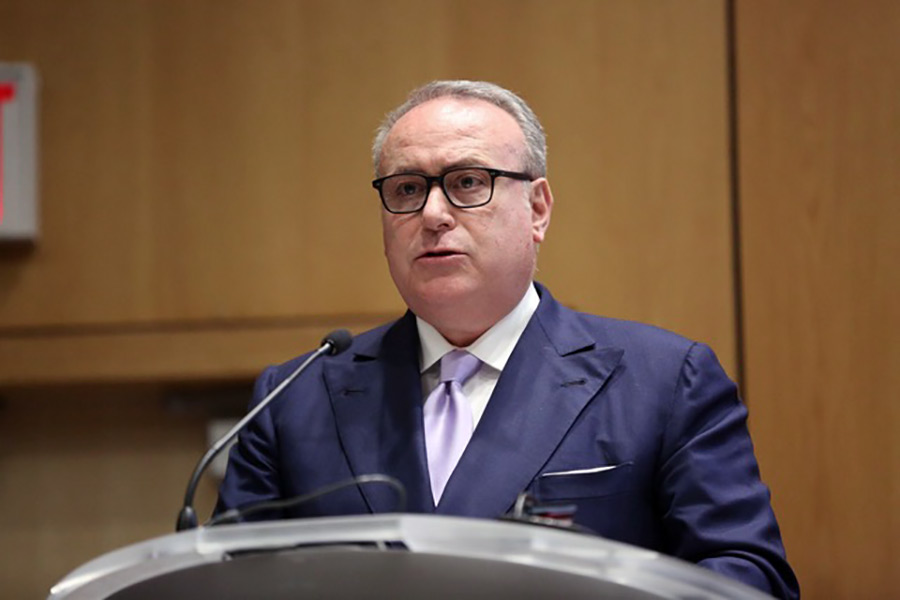
Andrea Mennillo’s Business Ethics Speech made at Fordham University’s Gabelli School of business

Opening remarks
Good afternoon to all of you. I want to thank Dean Rapaccioli for this opportunity to express my thoughts on the delicate relationship between ethics and business.
What is progress?
Today, more than ever, it is necessary to be aware that development must do two things: it must be profitable and it must respect a sound set of cardinal values.
In this digital age, where innovation and transformation permeates nearly our entire society – especially our ways of doing business –we cannot let discussion about progress ignore human behaviors and limits.
This issue is currently being debated by the Pontifical Academy for Life, the Roman Catholic Church institution that studies one of the most controversial ethical dilemmas in our life: science vs faith.
Science is founded on trial and empirical research. Faith is based on religious belief and mystery. So, which is the right path to recognizing the extraordinary progress that science can provide to human lives?
Of course, the right path is the one that is ethical. This is what the field of bioethics studies, and it is one of the more difficult matters that Christianity is debating.
Perhaps you are wondering if I came to the wrong course. Actually, I do know this is the Introduction to Business class taught by Dean Rapaccioli.
You are sophomores and you are preparing yourselves to become business people…in just a few years, you could face a critical life dilemma: the dilemma between greed and value with ethics.
As students at the Gabelli School of Business, you are in the right season of your lives to think deeply about this issue. You have the privilege of studying here and building your character before you confront ethical dilemmas in the daily workplace.
Of course, the workplace now is much different than when I entered it, as a chartered account at Price Waterhouse in the 80s.
The firm that became PWC was only just starting to get into business advisory services. We were mostly accountants and consultants, and there was just one computer in my entire department…we were obliged to share that single computer but also had to protect client information…this was a great opportunity to practice ethical behavior in the workplace.
Since then, almost every aspect of our lives and nearly every industry has been changed by the internet and other powerful technologies.
In very short amount of time, we have evolved to incorporate technology everywhere, but have lost touch with parts of our human nature.
Let’s learn from ancient Greece
Emotions…creativity…imagination…these all can help people to live well together. You know better than me how strongly we are now interconnected through social media but you also know how difficult it can be to share the best human qualities in the digital realm.
I believe that in our current networked society, ethics maintain their own privileged place, as a constant in human life. They are an important guide through the complexities of today.
To think about this, I want to talk for a moment about the past… more precisely, ancient Greece, the birthplace of Western philosophical ethics.
That is where ethical debates began. The ideas of Socrates, Plato and Aristotle revolved around the verb educating, which comes from the Latin words ex (out) and ducere (to lead), to mean bring out; it is equal to developing faculties and powers inside a person – to build up character…
The ultimate purpose of this educating activity was to make people aware they are creators and operators of civilization, and that they are able to shape society, improving it so all can live happily together.
Living well together was the ultimate purpose in the Polis
This is what the Greeks called Eudaimonìa. It comes from the words eu (good) and daimōn (spirit): that was their concept of happiness. Here we can see happiness as a purpose of life and as foundation of ethics.
Happiness had a precise role in directing one's conduct. According to Aristotle, happiness means to live in accordance with complete virtue, not for some chance period, but throughout a complete life. Happiness was an attitude of the soul.
This was the purpose of poleis, the ancient Greek city-states (the most complete form of political organization of Western history). In a polis, "living well" simply was the happiness of citizens, realized by logos, the rational principle that put together and gave a sense to life within the polis. Logos allows us to discuss and decide what is right and what is wrong, what is good or what is bad.
Mirror neurons confirm Greek philosophy
To Aristotle, polis has a very deep meaning. It is a community, a physical presence, a relationship. The community arises to make life possible and to produce the conditions for a good existence. To live individually is not enough.
More than 2000 years later, we can link this idea to a discovery by a renowned Italian neuroscientist, Giacomo Rizzolatti of University of Parma. In the 90s, Prof. Rizzolatti found the existence of mirror neurons when he observed that watching an action and performing that action activates the same parts of the brain, bringing about the same feelings.
Mirror neurons are why you cringe if you see someone slip and fall. They are the bricks of empathy – we all have them. These little cells program us to live in relation with others.
The art of character
Having established that we have a social brain, ethics and the art of working on our own character might be the key to building a more humane society based on mutual cooperation.
In the path of each person's life, there are two variables to consider: destiny, which we cannot influence, and character, which we can work on.
So, let’s talk about character…working on character requires commitment and responsibility. I believe our best guide is the four cardinal virtues: prudence, courage, temperance and justice.
To practice these virtues in our everyday interactions requires us to make conscious choices. They can help steer our decisions and show our limitations.
When greed overcomes character
For example, the financial and banking crisis took shape during the summer of 2007 because multinational banks, particularly in the U.S. and Europe, were unethical in their credit and financial transactions. This spawned a new regulatory framework to enforce discipline and prevent any market disruptions.
But we need to ask ourselves what sparked the global crisis. We do not have to dig deeply to see that too many bankers exceeded their limits, literally and figuratively.
Multinational banks, particularly in the U.S. and Europe, were unethical in their credit and financial transactions. Bankers let ambition and greed overcome their character, ignoring their role in their communities.
Ambition and greed are among what John Maynard Keynes described as animal spirits…human behaviors that motivate us to take on certain tasks.
These behaviors can be engines for our evolution and improvement. But we have to make sure that they don’t interfere our ethics and morals, because that is what leads to our downfall – professionally and personally. In the end, respect and honesty are the foundations for the lasting relationships that get the job done.
Trust is our most important asset
Doing business is a deeply personal activity where trust is the most important asset. Among the four cardinal virtues, prudence called Auriga Virtutum, the charioteer of the virtues, is considered the most significant one.
Prudence gives us the capacity for proper judgment – for applying principles and moral judgment, for allowing us to determine what is good and what is bad. To make proper judgments, you need to be humble. Otherwise your ego will interfere with your decisions.
Pope Francis has won strong support worldwide by emphasizing humility. He says humility is indispensable, but has explained that being humble does not mean being polite and courteous – being humble means being able to accept humiliations.
Accepting humiliation
Michael Milken offers an excellent example of accepting humiliation. At the height of success in the 1980s, the “Junk Bond King” made between $200 million and $550 million per year. Then he was found guilty of securities fraud and sentenced to ten years in prison.
Since he got out of prison, he has worked to atone for his crimes. He is promoting awareness of prostate cancer and raising money for medical research into serious diseases. He has been praised as someone who is helping improve medicine.
Andy Fastow, the disgraced former CFO of Enron, has been traveling around America since he got out of prison in 2011, giving lectures about how easy it can be to fall into unethical behavior.
Of course, it is better to accept our daily humiliations, admit when we are wrong, and avoid forgetting our ethics in the first place.
You can’t live outside the Polis
As you begin to take flight in your careers, there is another classic from ancient Greece that can help guide you. I try to always remember the myth of Icarus, who ignored his father’s warning and flew too close to the sun. Icarus overestimated his capabilities to the point that he lost touch with reality. His Hubris…his pride, stemming from privilege and power, ultimately led to his downfall.
To have the guts to admit to your own weaknesses and, unlike Icarus, to be aware of your own limitations is what will set you apart as you work towards your hard-earned successes. It is important to keep your pride in check with what the Greeks called Metis: wisdom and, again, prudence.
Ethics and business are not contradictory aspects of life – they are the winning path to sustainability. The challenge today is to prepare ourselves to be women and men with a sound set of cardinal values as well as financial notions and entrepreneurial spirit.
Remember, according to Aristotle, only angels or beasts can live outside the polis…we are mere women and men!
I want to leave you with this insight, and am happy to open the floor to your questions.
Thanks to all of you!
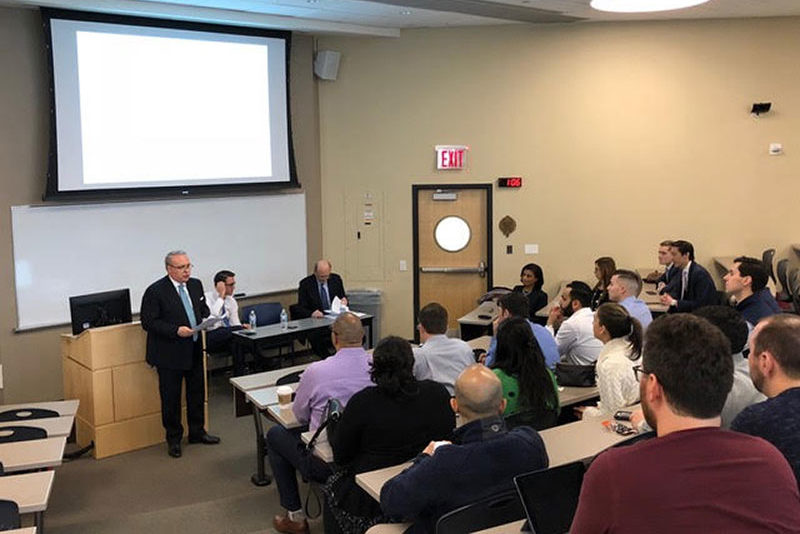
Andrea Mennillo’s opening speech on financial services in Europe made at Fordham University’s Gabelli School of business

Introduction of panelists
Good afternoon, and welcome to this timely event to discuss financial services in Europe.
Before we begin, I would like to congratulate with Dean Rapaccioli and her team for the growing success of these International Business Weeks. I firmly believe that the global approach we are discussing is vital for success in business today.
It is an honor to be on stage here two with respected leaders of the financial services industry.
Stefano Marsaglia, Executive Chairman of Mediobanca, has done it all over his thirty year career and Greg Minson, a Managing Director of Goldman Sachs, has also seen more than a thing or two since he got his bachelor’s in economics in Fordham 20 years ago.
Stefano and Greg, thank you both for taking the time to be here today.
It is easy for me to introduce Stefano and Greg – they have been my friends for a long time. I want this to be a more relaxed, informal panel where the whole audience feels welcome to participate in the debate with questions and comments.
Please take advantage of this discussion: experienced managers like Stefano and Greg have enriching insights about international business. Moments like this are an opportunity to learn from their concrete, daily work in this sector. Let’s be inspired by these two extraordinary experts.
The financial services market: Its dynamism and innovation can’t be turned off…
As a veteran of the financial services industry, I have experienced its innovative attitude. But well before my time, it has had a key role in the evolution of our society.
It goes back to the ancient Romans, who had to finance agriculture and wars, and the XIII century, during the period of the maritime republics, when the first banks were born.
If you Google “world’s first modern public bank,”1 you will read about Banco di San Giorgio, which was founded in 1407 in the Italian port city of Genoa.
Banco di San Giorgio was so powerful that Niccolò Machiavelli, the author of The Prince and father of modern political science, once described it as “a state within a state.”
Even in its early stages, evolution existed in the financial services industry. At first, banks mainly focused on trade and merchant transactions. But they soon became complex institutions that managed numerous complicated business streams.
Not long into my career, I had the opportunity to work for a medium-sized Italian bank led by a visionary CEO that allowed me, as part of the senior management team, to turn a local bank named BIPOP into one of the world’s largest online financial institutions.
Through its subsidiary, Fineco, BIPOP delivered triple-digit growth in asset and net profit for five consecutive years. In that time, its market capitalization jumped from €300 million to more than €20 billion, thanks to a business model that took advantage of innovations in online and multichannel distribution.
Based on that success, I firmly believe in innovation.
Later, I became CEO of La Centrale Merchant, a financial institution that had two large insurance companies as main shareholders: Generali from Italy and Allianz from Germany.
When I was in that position, Italy’s finance minister at that time, Giulio Tremonti, appointed me to the Experts Committee of Cassa Depositi e Prestiti, the biggest bank for infrastructure of the world.
Today, I still work doing advisory on infrastructure in high growth countries. Some call this activity “business diplomacy,” which I think is quite accurate because it requires balancing the needs of a wide number of stakeholders.
With regards to the financial services industry, we should remember the US and Europe chose different roads.
In the US, when President Clinton canceled the Glass Steagal Act in 1999, it allowed financial institutions to carry on both traditional banking and investment banking. Meanwhile, in Europe, these two businesses remained separate.
Yet financial services remains one of the most dynamic sectors of Europe’s economy. And in recent years, this sector has probably seen the largest number of unexpected changes in its history.
Probably you are immediately thinking of the consequences of the financial crisis that began in the summer of 2007… Yes, indeed this is one of the changes I am talking about, but not the only one. Not all of them were so negative…
Using a car race metaphor, I see the financial crisis as “only” a very tight curve taken at high speed. You do not necessarily go off the road; it depends both on the car you are driving and on your skills as a driver.
For example, look at what happened to derivatives in mid-2007. In the middle of the race, while the financial service market kept the accelerator down to move quickly towards new goals, the US ABS market suddenly collapsed, and derivatives market with it.
But this did not end the race … Certainly all financial institutions were shaken by this crisis, but as some fell down, others grew quickly by adapting to the new scenario. This illustrates the dynamism of this market.
A decade later, we can see that the derivatives market did not die. It is more active than ever. In the European Union alone, it reached an estimated notional value2 of more than €450 trillion at the end of February 2017.
In fact, we should now see even more clearly that derivatives are instruments for addressing business uncertainty, and not are an absolute evil. Of course, it depends on how you use them.
Apart from dynamism, innovation is an important feature of this industry.
Every day, new financial products are invented to meet the broadest range of needs. These new products widely vary in types, risks and complexities, but they are all pivotal to making business work.
Think about digitalization, which now is the leading trend in financial services. Immediacy, simplicity and automation characterize this digital age – financial services must achieve these qualities in their offer. It is not by chance that we are now experiencing the explosion of digital currencies and transactions thanks to the new, revolutionary blockchain technology.
Innovation represents the ability of this sector to continually revitalize itself, to always rapidly answer changes in the needs of market and clients, whether they are big or small companies, investors, individuals, consumers, governments, or public organizations.
Regulation and competition: Threat or opportunity?
But the most relevant words for this sector are regulation and competition.
Let’s talk about regulation. Over the last 15 to 20 years, we have seen how regulators have gradually become stronger, building a “fence” around the financial sector to avoid new crises and market shocks. This is especially true for Europe, but also at the global level.
In terms of international rules, we have the Basel agreements (the first in 1988, the last, Basel 3 in 2010), proposed by the Basel Committee, representing the central banks of the G10 countries, with the aim of giving clear international rules in bank supervision and aligning banks capital requirements at the international level. This was mostly necessary, considering the rapid process of globalization of this sector.
Personally, I began to better understand the impact of capital ratios when I was in the Strategic Management program at INSEAD in Fontainbleau. One of my Professors was Jean Vermine, who was a member of the commission in charge of introducing Basel 1 rules in Europe.
These rules are deeply rooted in Europe’s banking culture. The Basel 3 agreement in particular dictates liquidity and capital ratios, capital adequacy and leverage. The aim of the regulators is to control risks and mitigate losses. In short, the higher a risk the bank takes, the higher the capital the bank must have.
This has had a heavy impact on banks, making them more selective in granting credit to enterprises and therefore reducing their support for the economy.
As a consequence of Basel 3 rules, banks were obliged to improve their compliance and risk management processes, making them much more effective.
But, above all, banks were obliged to reduce leverage and to reinforce their capital. This meant:
- raising new capital on the market3
- requiring higher credit rating from clients
- selling bad assets4 like NPLs
- selling assets with high capital absorption, exchanging some business for cash
Consider that as soon as Basel 3 was communicated, European banks reduced their leverage ratio (measured as assets to equity) from an average of ~29x to 25x.5
In addition, to reinforce their capital, many institutions were forced to merge, which fueled the M&A market. Stefano will soon dive into this important topic.
On the other side, capital pressure created another important market. Recently we have seen the explosion in issues of NPLs as a legacy of years of economic slowdown. As a consequence of regulation, intermediaries were forced to get rid of the problematic assets.
The consequence was the arrival of operators who specialize in professional management of this type of risk, giving prompt support to the stability and profitability of the banking sector that was pressed by bad loans.6 These players are buying NPLs and creating value from their profitable management.
Here, we are benefiting from Greg’s experience, as at Goldman Sachs he created a successful business area completely devoted to NPL management.
But the total volume of NPLs across the EU is still very large, at €950 billion, so I think there is still a lot of work to do for people like Mr. Minson and his colleagues…
…and for his competitors, of course. As I said, the financial services market always offers good opportunities and will remain interesting for many new players.
Financial services are becoming a very crowded arena of different operators compared to several years ago. Traditional players are now facing newcomers from China and the Middle East. Countries that were not in the business until a few years ago are now dangerous competitors.
But this is what globalization means….
This is only one side of the coin, because on the other side of the coin we have increasing competition resulting from new technologies. We are living in the era of block chain, virtual currencies and FinTech.
The use of data and analytics to predict client needs, improve processes and services, and prevent fraud is becoming more common than ever.
Technology also brings more disintermediation. New players in the market, like Apple pay, Paypal and others offering complete “financial wellness platforms” are allowing clients to budget, bank, pay, and crowd-fund with their smartphones. Moreover, sometimes these players are not affected by regulation as traditional providers (so-called shadow banking).
But this is what digitalization means…
Competition and regulation are both positive tools for the efficiency of financial services markets, but of course rules must be equal for everyone and guarantee that competition goes for the benefit of users.
What’s the future?
In the global market, I think that Europe will remain the point of reference in this sector, regardless of Brexit.
FinTechs are for sure an opportunity for the entire economy: for retail users, for businesses and for traditional financial players.
In this sense, I firmly believe that we will see an increasing collaboration and alliance between more traditional players and new, innovative ones.
Of course, there remain risks and threats in the financial services market. They cannot be addressed just with rules or technology … what is needed are skilled, responsible managers who can combine attention to value with ethics.
Our esteemed panelists here are among the best guides we have for an overview of financial services, but they are also models of responsible managers.
So, Stefano, Greg … what can you tell our young audience about the next big changes in the financial services industry? For example, does technological change mean hard times for banks, or do you see a winning alliance between traditional banking and innovative services? What, in your opinion, are the main trends we will experience in this market?
Greg, Stefano, I leave you the floor…
1 www.ft.com/intl/cms/s/0/6851f286-288d-11de-8dbf-00144feabdc0.html#axzz2ycmbeCR9 “The World’s First Modern, Public Bank,” Financial Times Magazine. April 17, 2009.
2 Source ESMA: https://www.esma.europa.eu/press-news/esma-news/esma-produces-first-overview-eu-dernplivative-markets-size
3 Since 2014 to end 2017, banks in the euro area have increased their capital by EUR 234 billion and added EUR 813 billion of liquid assets. Source: European Commission
4 The average ratio of NPLs has decreased by one third since 2014 and is on a steady downward trend. Source: European Commission
5 Source: Bank of Italy Occasional Papers, “EU bank deleveraging”, September 2014
6 At mid 2017, the NPL ratio of EU banks declined to 4.6% (Q2 2017), reaching the lowest level since end 2014 Source: European Commission

Andrea Mennillo’s speech at International School of Monaco (ISM) 2014
Mrs. Pratte, Mr. Price, Mrs. Mackenzie-Wright ... International School of Monaco board of trustees, teachers and staff, fellow ISM parents, mesdames et messieurs ... and above all, ISM middle school students ... good morning.Read more

Andrea Mennillo’s speech at International School of Monaco (ISM) 2013
Mrs. Pratte, esteemed Board members, Mr. Price, Mrs. Mackenzie-Wright, International School of Monaco faculty and staff, mesdames et messieurs ... and most of all, ISM middle school students.